Built to Leave: The Real Job of an Interim/Fractional Integrator
The term "Fractional Integrator" has been a hot one lately in the EOS community. Oftentimes it is thought of as the integrator who supports businesses on a remote and part-time basis (in my experience, 5-10 hours per week) to lead L10 and Same Page meetings, conduct 1-on-1s with some or all of the Leadership Team members, and maybe take on a ROCK or two. And this model is certainly sustainable for a period of time with the right size company, with the right budget, and at the right stage of their EOS journey.
The sentiment around using a Fractional Integrator is often the same: that the client/Visionary is hungry for growth and wants every person in the organization to be just as hungry, just as committed, and just as willing to work weekends as they are to achieve the business' goals. So naturally when a Fractional Integrator enters the picture, the idea of a "part-time" executive doesn't seem to satisfy the hunger like having someone full-time in the role would.
This is where we must reset the narrative. Our jobs as Fractional Integrators are not to be the permanent solution for the organizations we support. Our point of entry is when the funds or the capacity to hire a full-time integrator are simply not there yet. We are not meant to be a permanent fixture - we are supposed to work ourselves out of a job over time if we are truly helping our clients grow and succeed. So yes, in a way, Fractional Integrators are all Interim Integrators in a sense… and are also a bit of a preview of what a full-time Integrator does for the business. We provide a glimpse of what it takes to drive forward momentum and prepare the organization for what's to come next. We are not the end game. We are the copilot to help get you to the next stop in your journey towards your final destination.
Regardless of the tenure, Interim/Fractional Integrators all face the same challenge:the need to build trust quickly with not only the Visionary, but across the organization as a whole. Sometimes these engagements cover short distances, like when the organization simply needs someone to keep the car on the road while they search for the long-term person to fill the seat. Other times, it's a longer route - filling seats, refining systems, and making sure the company is poised for transition before the wheel gets handed off. Either way, the destination is the same: a business that's ready to move forward without you in the driver's seat.
In a book called The Trusted Advisor, David Maister, Charles Green, and Robert Galford introduced a model called The Trust Equation, which measures trustworthiness using four key variables: Credibility, Reliability, Intimacy, and Self-Orientation. The formula is expressed as follows:
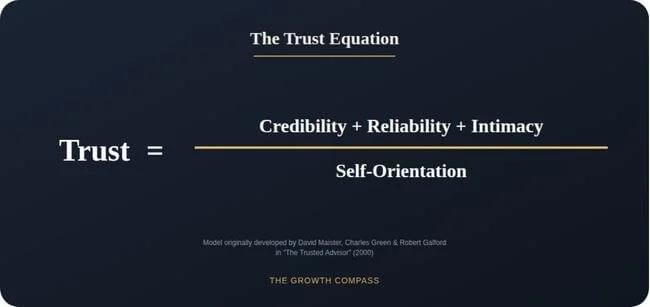
This formula means that, right out of the gate, Interim/Fractional Integrators must maximize their credibility, reliability, and intimacy with the team while evidencing a mild amount of self-orientation in order to build high amounts of trust rapidly. Many of us see this and think “How the HECK am I supposed to do all of that in the first month of my client engagement?!” Since time is not on our side as Interim/Fractionals, it’s critical to build aspects of this formula into each interaction we have with our client so that the evidence builds.
So what does that mean? I can’t speak for everyone, but here are some personal examples of what intentional trust building looks like for me:
Credibility: Credibility is tough because it’s often built through testimonials, thought leadership, and community exposure which all require time and outreach. As a fractional, the more prepared you are for every client interaction you have, the faster you can make recommendations that fine-tune your client’s business practices for even incremental amounts of improvement. You may have years of experience in this seat, but “winging it” doesn’t lend itself to showcasing your expertise. Do your due diligence and prove it, and this will help you build credibility quickly over a 6-12 month engagement period.
Reliability: Walk the walk and talk the talk. This is a non-negotiable in how I show up for my teams. I can’t claim perfection here, though I try extremely hard to follow through on every promise I make. And the best way to do that? By only committing to what is realistically feasible based on your capacity and capability. No one wants a yes-person as their Integrator, nor someone who is continuously letting down the team on delivery and follow-up. Being open and honest upfront will make it easier to build quick points on reliability over a quarterly cadence.
Intimacy: Of course this does not mean forming romantic relationships with your clients! But it does mean treating them how you would your own partner or family member… with respect, honesty, and humility. This means providing a safe space to talk openly about challenges without judgement. This means bringing empathy into decision-making by remembering the human element of business. This means folding appropriate personal context or feelings into the conversation to humanize the relationship. We all are getting our fair share of AI in our daily workflows now… we don’t need another robot on the other end of that video call.
Self-orientation: This is my favorite because to me it goes beyond the “put the client first” mentality, which many trusted advisors are taught. When I take on a new Interim/Fractional Integrator client, I make it my mission to drive home the fact that I am there to facilitate the success of the business above all else. I am not there to pump up the Visionary’s ego, to convince all team members to like me, or to capitalize on a chaotic operational structure. I am there to serve the business and help it achieve its vision, if only for a chapter of the 10-year target. Orienting myself towards the true north of the business’ V/TO is the message I bring to any decision I am a part of making - and I make sure that this is clear to all who interact with me.
Being an Interim/Fractional Integrator is never about building a permanent placeholder on the Accountability Chart - it's about building something transferable: trust, systems, and forward motion, fast. If you can hold the wheel with credibility, reliability, and intimacy, while keeping self-orientation low, you'll earn in months the kind of trust most permanent hires take a year to build. That's the job. Not to stay. To leave the business better than you found it, and hand the wheel to whoever - or whatever role - comes next.
If you're wondering whether an Interim/Fractional Integrator is the right move for where your business is right now, that's exactly the conversation I have with Visionaries every week. Let's talk through your seat, your timeline, and what "interim" could actually look like for you.