When an Integrator is a COO and When They Aren’t (And Why the Difference Matters)
This topic has made its way into many discussions within the EOS community, so for all of you Integrators out there having an identity crisis - this one’s for you!
The EOS Integrator is defined by accountability…not by title.
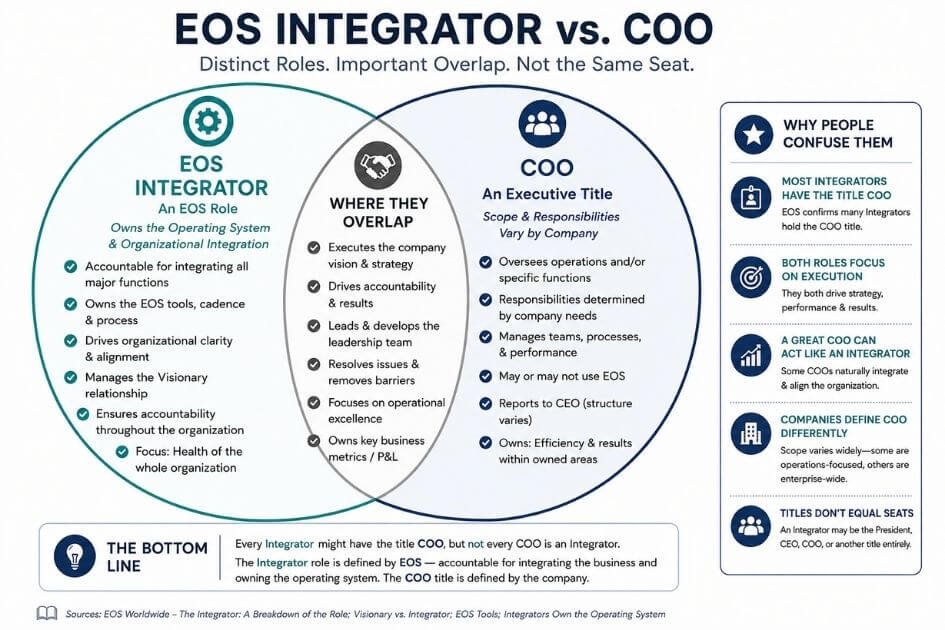
This is the simplest way to differentiate between the two. An EOS Integrator is not a title so much as it’s a definition of accountability. What do we do? We INTEGRATE vision - people - systems across the organization. Oversight of operations is certainly a part of that, but not the entirety of the role.
Then we look at the term “Chief Operating Officer” and what does that tell us? Nothing other than the fact that the role is in charge of business operations. There is no definition of accountability inherent in the COO title. That’s why this role looks so different from company to company. The requirements of a COO are spelled out with the company’s specific needs in mind: needs based on industry, product/service, and team structure, for example. The Integrator, however, is a role specifically defined by the Entrepreneurial Operating System. At its core, its primary accountabilities remain the same from organization to organization.
The EOS Integrator owns the operating system…not just operations.
While the core responsibilities of an “integrator” have existed as long as organized business has existed, the roles of “Visionary” and “Integrator” have been coined and popularized by EOS Worldwide as a part of the Entrepreneurial Operating System. This means the EOS Integrator is designed around EOS principles.
So naturally, the EOS Integrator is married to the EOS business model and is held accountable to its rollout and adherence across the organization. Alternatively, a COO may or may not be practicing EOS in their company - and depending on the structure of the team, the COO may not even be accountable to integrating whatever operating model their business has chosen.
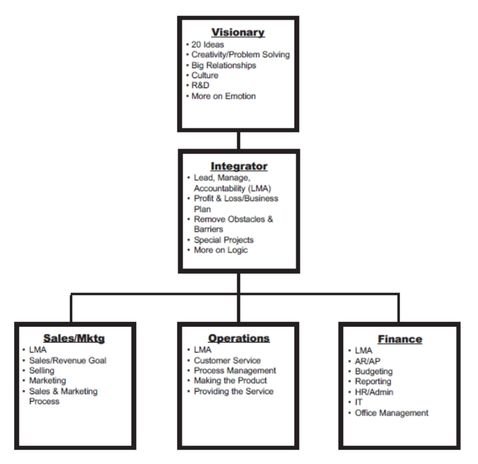
The EOS Integrator leads horizontally…many COOs lead vertically.
While the COO often asks: “How do we improve OPERATIONS?”, the EOS Integrator is thinking: “How can I get ALL FUNCTIONS (sales, marketing, finance, HR, operations, customer experience, technology, etc.) operating as one company under a shared vision?” This means that the EOS Integrator owns organizational alignment, while the COO may or may not own that responsibility.
The EOS Integrator is a systems architect - improving the connections between departments and not just a department itself. The Integrator ensures:
communication flows
priorities stay aligned
departments don't optimize at the expense of one another
everyone rows in the same direction.
The Integrator manages the Visionary relationship.
This is probably the most important distinction between an EOS Integrator and a COO. The EOS Integrator must possess a unique skillset: a skillset that requires patience, discipline, tenacity, and understanding; a skillset that is so rare that, according to research from EOS Worldwide, a 4-to-1 ratio of Visionaries to Integrators exists in the market.
This skillset is known as… managing the relationship with the company Visionary.
Finding someone who can balance big-picture creativity with day-to-day operational discipline is, quite frankly, a unicorn. An EOS Integrator must be able to LISTEN TO, INTERPRET, COLLABORATE, TRANSLATE, REGULATE, and TRUST in the Visionary if they are to succeed in this role. This means balancing two radically different leadership styles in the process of building a successful business. This means trusting in the Visionary’s passion while knowing how to filter and cascade the most important information across the organization and protect the team from Visionary-induced chaos and whiplash.
Speaking from experience, this is the most difficult part of being an EOS Integrator. And when done successfully, it is also the most rewarding.
The question isn't whether you are a COO or an Integrator. The real question is whether your company needs a distinct COO seat in addition to the EOS Integrator seat.
A company can have a COO without an Integrator, particularly if they are not running on EOS. It can also have an outstanding EOS Integrator who isn't called a COO. The distinction isn't about hierarchy or titles… It's about whether someone is accountable for integrating the entire business, protecting the operating system, and converting vision into consistent organizational traction.